
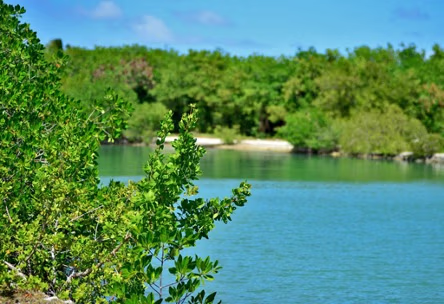
Mangroves are species of trees and shrubs that occur in the tropics and subtropics, forming clusters along the coastline. These species have adapted to live in brackish and/or saltwater, and to being (partially) submerged during high tides. They make up the transitional zone between the ocean and land.
In the Dominican Republic there are four species of mangroves: red mangrove (Rhizophora mangle), black mangrove (Avicennia germinans), white mangrove (Laguncularia racemosa) and buttonwood (Conocarpus erectus). They are usually found in this same predictable order from the shoreline towards inland, because of their different levels of tolerance to salinity and inundation. Red mangroves grow in the least elevated areas bordering shorelines and are easily recognized by their distinctive arching roots. The black mangrove is the most salt tolerant, as it grows in hypersaline conditions to the back of the mangrove zones in the upper intertidal areas that are occasionally flooded. White mangroves occur in patches on higher elevations that are less frequently flooded. Buttonwood is found the furthest distance from the coast, in areas seldom inundated by tidal waters in rocky, dry habitats.
Mangroves offer a variety of services that benefit both the environment and humans. They act as sanctuaries to many marine and terrestrial species. The roots serve as spawning grounds for species of fish and marine invertebrates, where food availability and the calm environmental conditions allow for reproductive success. Furthermore, mangroves filter toxins and nutrients out of the water, improving the quality of the water wherever they are. Their roots also help reduce coastal erosion and keep our coasts safe by keeping sediment in place and dissipating wave energy when conditions in the ocean get rough.
By acting as a refuge for fish species, many of which are commercially important, mangroves increase food security in coastal areas. Additionally, they provide an invaluable green economy for humans.
Above all, mangroves act as carbon sinks and thus remove carbon dioxide from the atmosphere. This is known as blue carbon, where carbon is captured from the atmosphere by the tree leaves, and subsequently stored as sediment in the roots below water. The capture and storage of carbon by mangroves and other blue carbon ecosystems is an important buffering mechanism to cope with climate change and global warming.
Mangroves are rich ecosystems full of biodiversity. You can find terrestrial species such as different kinds of birds, lizards and snakes, as well as marine species such as juvenile fish, sea turtles, manatees, crabs, oysters and sponges.
In Cap Cana, you get to admire these important ecosystems in different spots: in Punta Palmera, the Secrets Resort, Lago Azul and the lagoon near Farallón Entrance