
A few weeks have passed since the Cap Cana tournament, but Mariano Navone’s name continues to gain traction in the tennis world.
And not by chance.
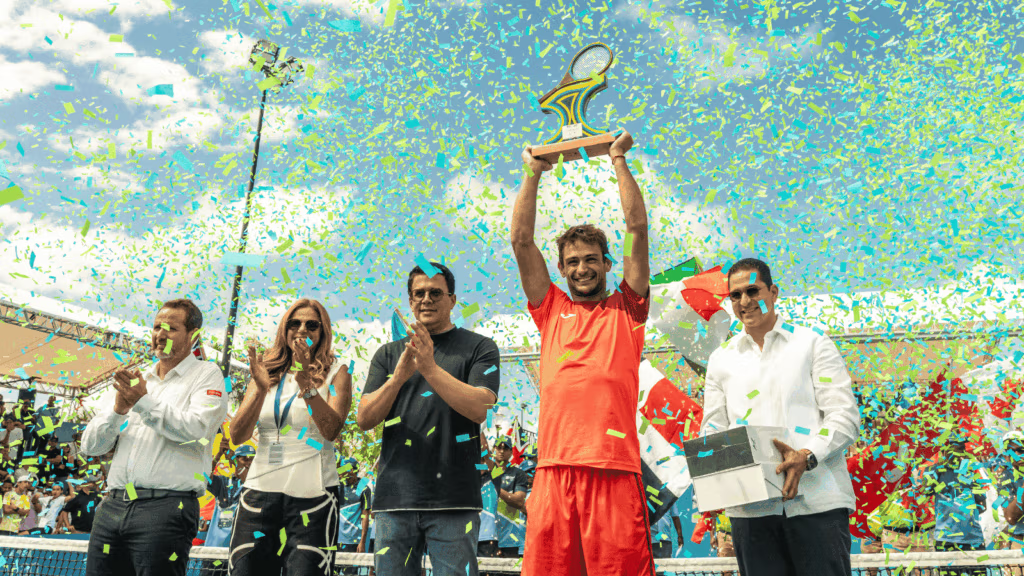
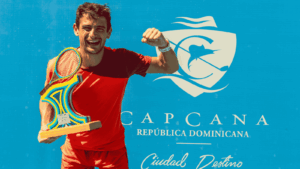
The 25-year-old Argentine claimed the title at the República Dominicana Open Copa Cap Cana ATP Challenger 175, one of the most relevant recent tournaments in the Dominican Republic, securing the biggest title of his career and, even more importantly, his first win on hard courts.
For those searching what happened in Cap Cana this season or looking to understand who Mariano Navone is, this result marks a turning point.
This wasn’t just another win
Navone had built his career almost entirely on clay courts, a surface deeply rooted in Argentine tennis development. In fact, all of his previous ATP Challenger titles had come on clay, which makes this victory in Cap Cana particularly significant. It proved he can compete and win beyond his natural surface.
Cap Cana was the stage for his biggest achievement
In the final of the ATP Challenger Cap Cana, he defeated Mattia Bellucci 7-5, 6-4 in a match that lasted over two hours. Beyond the scoreline, it was a win built on consistency, controlling long rallies and dictating the rhythm of play.
The impact on the ATP rankings was immediate
With this result, he earned 175 ATP ranking points, won US$48,000 in prize money, and climbed 18 positions to reach world No. 61, marking a significant step toward establishing himself on the main ATP Tour.
His path to the title was solid
The draw at the Cap Cana ATP Challenger was far from easy. Navone defeated Nick Hardt, Shintaro Mochizuki, Valentin Royer, and Alexander Blockx, reaching the final after a demanding semifinal, while his opponent had a relatively smoother run.
He is entering a new stage in his career
This result also aligns with a key change: his new partnership with coach Alberto Mancini, former mentor to Guillermo Coria and Fabio Fognini. At this level, coaching shifts often signal a new phase of development.
He handled demanding conditions
The tournament in Cap Cana was played in temperatures above 30°C, typical of the Caribbean but physically demanding. Even so, Navone remained composed, managed key moments –including a heat break– and maintained his level through the final stages of the match.
He said it himself
After the win, Navone made it clear what this moment represents. In statements reported by Tennis.com, he said:
“I had been looking for a result like this on hard courts for a long, long time. We learned to play on hard courts later in our careers. Argentine players grow up on clay, but here in Cap Cana I find conditions that suit me well because the ball bounces higher.”
More than a quote, it reflects his evolution: this is not just about winning on a different surface, but learning how to play on it.
His background explains his game
Navone developed his game in Argentina, where tennis is traditionally played on clay courts. That background translates into a style defined by baseline consistency, endurance in long rallies, and strong match awareness. He is not a highlight-driven player, but a structured one.
He represents a new generation of Argentine tennis
Following players like Juan Martín del Potro and Diego Schwartzman, Navone is part of a new generation redefining Argentine tennis, less limited to clay courts and increasingly competitive across all surfaces.